Although this drawing lesson was written with kids in mind, it’s fun for adults, too. This how to draw video series is the result of teaching children how to draw in Young Rembrandts for over twenty years!
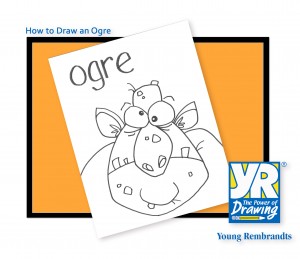
Learning how to draw an ogre is easy with my “How To Draw” video. Let’s get started…
It was a rainy Saturday morning and four year old Brayden was looking for something to get busy with. He got out his crayons and drawing paper and came to find grandma. He thinks that because I can draw – I am his personal illustrator and coloring book. But instead of me doing all the drawing – we drew and colored together.
First I drew the rocket ship he wanted. Together we drew lots of circles that made the planets and far away stars in space. Then Brayden colored the rocket ship and all the planets – leaving me the dark, dark sky. He knew he left me the ‘big’ job, and was very complimentary about how well I colored. Good to know I can still impress a four year old!
Have you been labeled – scatter brained, distracted, inattentive, even impulsive? Has your child? Perhaps ADD or ADHD diagnosis has been away to explain these behaviors. Diagnosing ADD or ADHD is highly subjective and comes with a multitude of negative connotations. But what if it’s not a negative? What if its not even ADD ?
What if you are operating exactly like you’re supposed to?
What if instead of being deficient – you are actually quite gifted?
What if you could start seeing the gift – the opportunities?
What if you could harness and shape your gifts to work for you and not against you?
There’s good news. Visual learners share many of the same traits as ADD. Visual learners need more visual, hands on learning experiences and often struggle to organize, stay on task and pay attention. This is increasingly apparent with children in today’s language heavy, test oriented classrooms. And yet there are great advantages to being a visual learner. Some of our most creative minds, great leaders and innovative business people have been and are visual thinkers.
You may not need another activity to add to an already busy spring, but in case you’re looking for some get-me-going inspiration, here are a few fun activities to share with your family…
Build an Art Spot. The key to success is to make sure your spot is well supplied; and that little artists can utilize it without the need of adult supervision. This means washable mediums; and place-mats, aprons or old clothes that make clean up a cinch. If you’re short on room, a low and easy-to-open drawer works well – loaded with paper and compartmentalized, tote-able supply bins. Want to really go all out with your space? Here are some amazing ideas to inspire you.
No TV Family Nights. Try “Play Night” where the kids or the whole family can dress for the event and put on a play. Here are some free playscripts to follow. You could also organize a “Kids Choice Night”; kids can pick their dinner and an activity from a parent-approved list; like bowling, a drawing session, or a backyard camp-out!
“I’m not smart. I’m not the same as the other kids. How come I don’t get good grades like they do? I’m not smart like they are.”
I met with a group of parents to share information about learning styles and ways to help our visual learning children do better in the classroom. A mother seated in the front row had raised her hand and asked that question about her 9 year old daughter.
Get the best tips to make homework and learning easier for everyone especially the visual learner and make it easy for you to stay ahead of the curve and keep your child on top.









 how to draw in Young Rembrandts for over twenty years!
 It was a rainy Saturday morning and four year old Brayden was looking for something to get busy with. He got out his crayons and drawing paper and came to find grandma. He thinks that because I can draw – I am his personal illustrator and coloring book. But instead of me doing all the drawing – we drew and colored together.


 I met with a group of parents to share information about learning styles and ways to help our visual learning children do better in the classroom. A mother seated in the front row had raised her hand and asked that question about her 9 year old daughter.