








Visual Learner
A Family Wedding: Collaboration or Collision?

We recently had a wedding in the family – our first. While planning and executing such a grand and lovely event was thoroughly enjoyable, it was also a brilliant study on the way left and right-brain people approach a given task.
Our oldest daughter, the bride, is a visual-spatial thinker, full of ideas and vision; there’s a lot of that going on in our family. The groom’s, a social, left -brain analytical thinker, prefers numbers, budgets and excel spreadsheets; there’s a lot of that going on in their family. When it came time to plan the wedding, the right-brain, visual bride and bridesmaids immersed themselves in magazines, websites and social media, searching out ideas – visually. Pinterest became a family obsession, with everyone in the family searching out and sharing ideas. A few trips to stores, photographers, florists and wedding vendors, brought more options and ideas.
ADD and ADHD: Has your child been labeled?
Have you been labeled – scatter brained, distracted, inattentive, even impulsive? Has your child? Perhaps ADD or ADHD diagnosis has been away to explain these behaviors. Diagnosing ADD or ADHD is highly subjective and comes with a multitude of negative connotations. But what if it’s not a negative? What if its not even ADD ?
- What if you are operating exactly like you’re supposed to?
- What if instead of being deficient – you are actually quite gifted?
- What if you could start seeing the gift – the opportunities?
- What if you could harness and shape your gifts to work for you and not against you?
There’s good news. Visual learners share many of the same traits as ADD. Visual learners need more visual, hands on learning experiences and often struggle to organize, stay on task and pay attention. This is increasingly apparent with children in today’s language heavy, test oriented classrooms. And yet there are great advantages to being a visual learner. Some of our most creative minds, great leaders and innovative business people have been and are visual thinkers.
How Children Learn: 10 Tips for Teaching Visual Learners
 Imagine my excitement when Education.com asked me to share insight from my book, Being Visual. What an honor! If your child is a visual learner, they may be struggling in the classroom. Understanding learning styles is a fantastic way to help a child succeed academically. We parents don’t like to settle for anything less then success for our kids and I’m excited to have the opportunity to help.
Education.com is a great resource for parents and educators. They
How Children Learn: 10 Studying Activities for Visual Kids
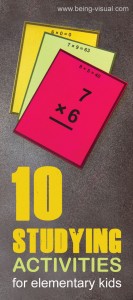 Right brain, visual-spatial individuals are conceptual, non-linear thinkers and they often miss details, struggle with memorization and prefer images over words. Visual students don’t usually test well. Some may even struggle with test anxiety. But there are always going to be tests at school and we need to help our visual kids conquer their fears and improve test scores.
Here are 10 studying activities to help your visual elementary kids study:
- Make learning visual – When classroom material is presented visually, your visual student is already on their way to more successful studying. These learners remember images – not words.
- Write notes – The physical act of writing actually helps visual kids remember. Write very simple notes over and over again to help remember.
- Add Images – Along with writing words, add simple images to help trigger memory. This is great for vocabulary practice. Again, visual kids remember pictures – not words.
- Use color – Add color whenever you can. Take notes in color. Write key words in color. Write on colored notecards. Use a highlighter to help ‘see’ key information.
- Make vocabulary colorful –To practice vocabulary words, write each one on flashcards. Add an image. Use colored markers, or colored notecards. Take the learning even further by using a different color for each syllable.
How Children Learn: 3 Ways to Help Your Child Succeed in School
What do you say to your child when she tells you…
“I’m not smart. I’m not the same as the other kids. How come I don’t get good grades like they do? I’m not smart like they are.”
 I met with a group of parents to share information about learning styles and ways to help our visual learning children do better in the classroom. A mother seated in the front row had raised her hand and asked that question about her 9 year old daughter.
How Children Learn: What are the different learning styles?
 All I wanted was to do art with kids — to teach and empower — to see their sweet faces light up with every new discovery. My young students thrived when they got the “how to” information they craved. And while teaching children how to draw, they taught me — again and again — how important art is to them. In my book, Being Visual, I talk about my 20 years experience teaching young kids how to draw by using their preferred learning style. The classes and teaching method were popular and effective, so I made a business out of it. But it’s never really been about the business.
10 Ways to Help Your Visual Child Study
Visual students don’t usually test well and may even struggle with test anxiety. Right brain, visual-spatial individuals are conceptual, non-linear thinkers and they often miss details, struggle with memorization and prefer images over words. But there are always going to be tests at school and we need to help our visual kids conquer their test […]
How To Tell If Your Child Is A Visual Learner
 As parents, we have a vested interest in understanding the nuances of left and right-brain thinking. A child’s ability to learn is directly affected by the way their brain sees and processes information. Knowing if your child is an auditory, visual or kinesthetic learner will enable you to choose activities that support their learning needs, while working to develop their weaker areas. Click HERE to take our quiz and find out if your child is a VISUAL learner!
Preschool Art: Teaching How to Draw
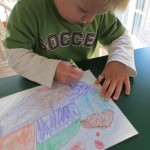 Brayden has the distinct advantage of having drawing classes at home. As the founder of Young Rembrandts, I’ve taught thousands of preschool kids how to draw, but always enjoy special time with my grandson.
