We had some fun when we headed to the WGN-TV news studios in downtown Chicago. After reviewing my newly launched book, Being-Visual, I was thrilled that WGN invited me to appear on a “Focus on Family” spot, to share tips on helping visual kids do better in the classroom. Originally, the segment was scheduled to be taped live and I must admit, knowing the large audience that WGN reaches, a bit of nervousness settled upon me. However, news about the Chicago teachers strike forced the station to make some changes to their schedule, so we taped our session to be aired at a later date this month on September 25.
That small bit of change did not lessen the fun of being at the studio, meeting Dina Bair and being excited about sharing strategies to make visual kids more successful. Dina is very knowledgeable, a gracious host and generous interviewer. In our show and tell segment, I shared strategies for making tasks visual, using color to engage elementary kids in study, organizing thoughts with sticky notes before writing and using chocolate to teach math concepts.
Tune in to WGN, Focus on Family September 25th, and get tips on how to help your kids at home!
After a long summer filled with a variety of activities, it’s time for kids to head back to the classroom. Unfortunately, for many kids this means a lot of time sitting in chairs and listening. If your child has trouble paying attention, gets fidgety, displays disruptive behavior, makes careless mistakes, has difficulty organizing and completing assignments—they may be recommended for an ADD evaluation. It extremely important to find out what’s distracting them, but rest assured, it may have nothing to do with ADD.
Most of us have heard about ADD and may even use it to describe ourselves, especially when we’re feeling a bit scattered or distracted. ADD, Attention Deficit Disorder, is a condition characterized by an inability to concentrate, hyperactivity and impulsive behavior. Unfortunately, ADD and ADHD diagnoses are on the rise and prescriptions for medication have dramatically increased. While researching my book, Being Visual, I came across the work of Jeffrey Freed, M.A.T., a private education consultant and co-author of Right-Brained Children in a Left Brain World: Unlocking the Potential of Your Add Child.According to Freed, “ADD is by far the most commonly diagnosed ‘psychiatric’ problem in children; it accounts for about 50% of child and teen visits to mental health clinics. Children are labeled ADD as the result of a highly subjective evaluation process.”
While ADD and ADHD genuinely affect 2 to 3% of the population, a small portion of those currently diagnosed, Freed’s work suggests other explanations for their classroom challenges. After years spent working with thousands of children, he found that “virtually all children with ADD share the same learning style.” As it turns out, ADD kids are highly visual, non-linear thinkers that need mental images to learn. They’re visual- spatials! And it makes sense, because they have many of the same “symptoms”. Visual-spatial kids make careless mistakes in school work, have difficulty organizing, trouble paying attention in language-oriented classrooms, and difficulty sitting still and focusing on linear, language-oriented tasks. This is good news, because the teaching techniques that work for right-brain, visual students are also effective with kids labeled as ADD.
So parents, rest assured—your distractible, restless, non-linear kid is likely just fine. Click here to find out if your child is a visual learner and ways you can help.
I recently took a mini-vacation with my oldest daughter. We spent a few days together in sunny Montauk, NY, enjoying the beach and delighting in the spectacular views of the Atlantic Ocean. While my daughter and I always enjoy our time together, I was also blessed to have Julia Child join us.
As I lay on the beach in Montauk, I read about Julia’s celebrated life in Dearie: The Remarkable Life of Julia Child, by Bob Spritz (2012). My book, Being Visual, details the needs, struggles and strengths of visual, kinesthetic learners, so imagine my delight when I read that Julia, famous chef, author and television personality, was a visual, kinesthetic learner!
It seems Julia’s mother recognized her need for visual, tactile learning and enrolled her in a Montessori kindergarten. Her biographer shared that Julia was “sent to a nearby Montessori school that emphasized hands-on activities—seeing and feeling and doing—as opposed to the imaginative play of most kindergartens. She mastered the school’s physical drills intended to develop a youngster’s hand-eye coordination: hammering round pegs into round hole, squares into squares: organizing containers so they fit inside one another; rearranging alphabet blocks in their proper order.”
It seems that while Julia had an excellent education, including a college degree from the prestigious Smith College, she didn’t excel in the academic classroom. Julia didn’t consider herself “an intellectual type,” which caused her some insecurity; she longed for purposeful work that suited her. Eventually, right-brained, kinesthetic Julia moved to Washington, and then overseas during WWII, to manage the strategic operations office of the OSS. Her divergent thinking abilities, natural curiosity and discipline were well-suited for the unique position.
Some years later, Julia learned to cook, collaborated on writing her debut cookbook, Mastering the Art of French Cooking, and starred in the first educational television show. This visual, kinesthetic, “non-academic” woman had a remarkable career that changed the attitudes, beliefs and behaviors of an entire culture and set a food revolution whose impact is still felt today.
Julia Child is just one example that there are many kinds of smart in this world, and we “non-academic”, visual, kinesthetic types have a lot to contribute—we may even change the world!
While the typical family is enjoying a casual summer schedule, research shows that the typical student brain is also taking a summer break and forgetting up to 40% of the information learned during the school year. Worse yet, can take up to 6 weeks to get back into the swing of learning once a student returns to school. In the average school year, that can add up to almost 50% learning loss overall, an overwhelming statistic in a make-it-or-break-it educational environment. The good news, however, is that while it’s easy to forget – it’s just as simple to put a plug in the drain and keep that brain active, engaged and learning while still having fun through the summer break.
First and foremost, to have learning success over the summer, students should be kept on a schedule. For example, every morning can begin by making our beds, brushing our teeth, getting dressed and eating breakfast. Afternoons can be left for an abundance of summer activities that will keep kids learning without realizing it! A summer schedule with room for free play and plenty of choices will keep kids learning, having fun, and allow for a smooth transition into the next school year.
But how do we keep up with specific academic skills like reading, math, science and writing?
To keep kids excited about reading over the summer, consider a reading program. Many libraries and elementary schools offer themed programs that offer rewards after the program is complete. The “reward” is a great way to keep kids motivated until they develop an intrinsic love of reading.
Kids should also have plenty of opportunities to read at home. Set out a variety of material from poems to magazines and books that cover a variety of genres in fiction and nonfiction categories. The key here is to give your child a choice and the time to do it. All it takes is 20 to 30 minutes a day to hone in and retain those reading skills.
Journaling is a wonderful way to keep the fun in writing while making memorable summer keepsakes. Drawing and writing about their summer experiences will develop their fine-motor and communication skills while organizing their thoughts – all important academic skills that will carry through all subjects in school.
And what about math and science?
Try a “work-pay” chart instead of an allowance. For making the bed pay a quarter, for the toys in the basement 50 cents. Allocate the funds once a week and you’d be surprised how quickly kids of all ages learn to add money! How about counting how many pairs of eyes are in a room by 2’s, or how many fingers and toes by 5’s. At dinner, you have 5 green beans left, when there’s 0 left you can have dessert! Applying math in these everyday practical ways drive home the fundamentals far better than memorizing flash-cards or adding in a workbook.
Science can be just as fun. Inspire curiosity! How long will it take to freeze a lemonade popsicle (and how many licks does it take to eat it)? What kind of flowers do honeybees like? How does a lightning bug light up? The point in summer science is not to memorize the periodic table or learn the Latin names of your flower garden, but to learn to ask questions and enjoy finding the answers.
Summertime is a wonderful opportunity to show that learning doesn’t have to happen in a classroom and it doesn’t have to involve a test. Learning can and should be fun, and should be a lifelong adventure. With a little planning, a consistent schedule and a little imagination, your children will retain what they’ve learned in the previous year and be leaps ahead in the new one.
Get the best tips to make homework and learning easier for everyone especially the visual learner and make it easy for you to stay ahead of the curve and keep your child on top.








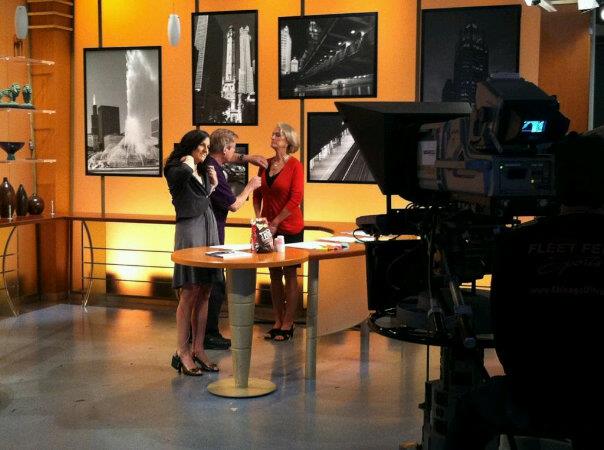 We had some fun when we headed to the WGN-TV news studios in downtown Chicago. After reviewing my newly launched book, Being-Visual, I was thrilled that WGN invited me to appear on a “Focus on Family” spot, to share tips on helping visual kids do better in the classroom. Originally, the segment was scheduled to be taped live and I must admit, knowing the large audience that WGN reaches, a bit of nervousness settled upon me. However, news about the Chicago teachers strike forced the station to make some changes to their schedule, so we taped our session to be aired at a later date this month on September 25.


